Agile Transformation
Agile Transformation
A practical guide to successfully transitioning from traditional ways of working to Agile, with strategies for mindset, roles, collaboration, testing, communication, and organizational change.
15 January 2026
In today's fast-paced business landscape, adopting Agile ways of working has become an important strategy for organizations seeking to improve productivity, accelerate delivery, and respond more effectively to changing customer and business needs.
However, transitioning from traditional, Waterfall-based ways of working to Agile can be challenging. Organizations may encounter skill gaps, resistance to change, unclear responsibilities, communication barriers, and difficulties in changing established processes.
Successful Agile transformation therefore requires more than simply introducing Scrum, Kanban, or Agile ceremonies. It requires a strategic and cultural shift involving people, processes, leadership, technology, and continuous improvement.
In this article, we explore several strategies that can help organizations successfully navigate an Agile transformation.
1. Embrace the Agile Mindset
Agile is more than a process or a collection of practices. It represents a fundamental shift in how teams think about collaboration, change, delivery, feedback, and continuous improvement.
To succeed with Agile, teams need to embrace an environment characterized by:
- Collaboration rather than organizational silos
- Openness to change
- Continuous learning and improvement
- Frequent feedback
- Shared ownership
- Transparency
- Focus on delivering customer and business value
This fundamental shift in thinking is essential for adapting to new ways of working and ensuring that people understand why the organization is changing.
Agile transformation is not something that can be achieved overnight. It requires careful planning, staged implementation, leadership support, and consideration of the people affected by the transformation.
Using the Diffusion of Innovation Model
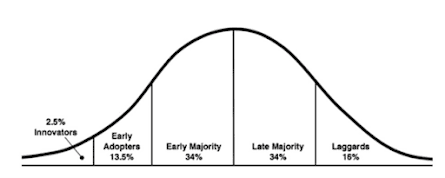
One useful approach for understanding adoption is the Diffusion of Innovation (DOI) theory developed by Everett M. Rogers.
The model categorizes people according to how quickly they adopt new ideas and innovations:
Innovators → Early Adopters → Early Majority → Late Majority → Laggards
Understanding where people fall within these categories can help transformation leaders develop a more effective adoption strategy.
Innovators
Innovators are individuals who are eager to experiment with new ideas. They are often willing to take risks, try new approaches, and provide early feedback.
During an Agile transformation, innovators can become early champions of the change because they typically require very little persuasion.
A practical approach is to involve these individuals early and allow them to experiment with new Agile practices.
Early Adopters
Early adopters are generally open to change and can quickly recognize new opportunities.
However, they often want to see evidence that an idea can work before fully embracing it.
Demonstrating successful Agile practices through pilot teams, successful initiatives, or examples from other parts of the organization can help gain their support.
Early Majority
The early majority typically prefers proven approaches rather than experimentation.
They are more likely to adopt Agile practices after seeing evidence that the approach works.
Success stories, measurable improvements, testimonials, and examples from pilot teams can help build confidence among this group.
Late Majority
The late majority tends to be skeptical of change and usually adopts new practices after they become widely accepted.
Rather than attempting to convince everyone immediately, transformation leaders can build momentum by first establishing successful examples and creating a growing community of supporters.
As adoption increases, the late majority is more likely to become comfortable with the transformation.
Laggards
Laggards are generally the most resistant to change and may strongly prefer existing ways of working.
They may require additional evidence, peer influence, training, and structured support before accepting new practices.
Transformation leaders should avoid attempting to change the entire organization simultaneously. Building momentum with willing adopters first can create the evidence and organizational confidence needed to gradually address more resistant groups.
2. Redefine Responsibilities and Roles
Agile transformation requires organizations to rethink traditional roles and responsibilities.
This goes beyond improving collaboration between developers, testers, and business stakeholders. IT, business analysts, product teams, project managers, operations, and other departments may all need to adapt their roles and ways of working.
Traditional top-down control should gradually give way to greater collaboration, transparency, and shared ownership.
Management also has an important role to play.
Instead of controlling every aspect of delivery, leaders should increasingly focus on:
- Removing organizational barriers
- Providing strategic direction
- Enabling teams to succeed
- Creating alignment
- Supporting decision-making
- Encouraging continuous improvement
At the team level, Agile encourages greater self-organization, accountability, and ownership.
The objective is not simply to change job titles. The objective is to change how responsibilities are understood and how decisions are made.
3. Encourage a Whole-Team Approach
Agile encourages a whole-team approach in which people collaborate from the beginning rather than working in isolated stages.
Team members should work together to:
- Understand requirements
- Define solutions
- Identify risks
- Plan delivery
- Validate outcomes
- Maintain quality
- Review progress
- Improve continuously
Quality should not be considered the sole responsibility of testers.
Testers, developers, product managers, business stakeholders, designers, analysts, and other team members should contribute to discussions about quality and customer value.
Regardless of individual roles, the team shares responsibility for successfully delivering each increment.
This may include supporting activities such as:
- Testing
- Peer reviews
- Documentation
- Refinement
- Analysis
- User feedback
- Technical validation
A whole-team mindset reduces handoffs and encourages shared accountability.
4. Test Early and Continuously
Agile places strong emphasis on testing throughout the delivery lifecycle.
Rather than waiting until the end of development to validate the product, teams should identify and address quality issues as early as possible.
Continuous testing can include:
- Unit testing
- Integration testing
- Automated regression testing
- API testing
- Security testing
- User acceptance testing
- Exploratory testing
Automated tests integrated into Continuous Integration and Continuous Delivery pipelines can provide rapid feedback whenever changes are introduced.
This helps teams determine whether new code meets expected requirements without unintentionally breaking existing functionality.
The earlier defects and misunderstandings are identified, the less expensive they generally are to address.
5. Embrace Agile's Iterative Nature
Unlike traditional linear delivery approaches, Agile encourages iterative and incremental development.
Instead of attempting to define and deliver everything at once, teams work in smaller increments and continuously learn from feedback.
This enables teams to:
- Deliver value earlier
- Validate assumptions
- Adapt to changing requirements
- Reduce delivery risk
- Incorporate customer feedback
- Improve continuously
Agile teams therefore need to remain flexible.
Priorities may change. Requirements may evolve. New information may emerge.
The objective should not be to protect an outdated plan at all costs. Instead, teams should focus on maximizing value while adapting responsibly to new information.
6. Foster Open and Transparent Communication
Effective communication is one of the foundations of successful Agile teams.
Agile encourages team members to share information openly, raise concerns, discuss obstacles, and contribute ideas.
This can be challenging in organizations where communication has traditionally followed a strict top-down structure.
A healthy Agile environment encourages people to:
- Speak openly about problems
- Share progress transparently
- Raise risks early
- Discuss mistakes without fear
- Ask questions
- Collaborate on solutions
- Provide constructive feedback
Transparency should not be confused with surveillance or excessive reporting.
The objective is to ensure that the right information is visible to the people who need it so that informed decisions can be made quickly.
7. Prioritize Early Feedback and Re-planning
One of the major advantages of Agile is the ability to identify problems early and adjust accordingly.
Feedback can come from multiple sources, including:
- Sprint or iteration reviews
- Customers
- Product stakeholders
- Automated tests
- Production data
- Team retrospectives
- Business outcomes
This feedback should be treated as an input for decision-making rather than as a threat to the original plan.
When new information indicates that priorities need to change, teams should be willing to re-plan.
The objective is continuous learning and improvement.
Plan → Build → Validate → Learn → Adapt
This feedback loop is central to successful Agile delivery.
8. Engage Both Management and Teams
Successful Agile transformation requires active involvement from both leadership and delivery teams.
Transformation cannot be delegated entirely to an Agile Coach, Scrum Master, PMO, or transformation office.
Leadership must provide:
- Clear strategic direction
- Sponsorship
- Resources
- Organizational support
- Decision-making authority
- Removal of systemic impediments
At the same time, teams need opportunities to participate in the transformation and influence how Agile practices are introduced.
Using AIDA to Understand Stakeholder Readiness
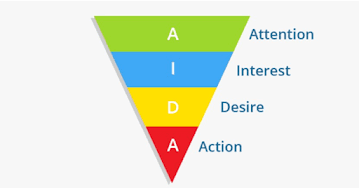
The AIDA model — Attention, Interest, Desire, and Action — can provide a useful lens for understanding stakeholder readiness during a transformation.
Attention
At the Attention stage, stakeholders are becoming aware of the transformation.
Their questions provide an opportunity to explain the purpose, expected outcomes, and reasons for change.
Clear communication is particularly important for stakeholders who have limited awareness of Agile or the proposed transformation.
Interest
At the Interest stage, stakeholders understand that a transformation is being considered and want to understand its implications.
They may ask questions about:
- Benefits
- Costs
- Disruption
- Organizational impact
- Risks
- Expected outcomes
At this stage, demonstrate how the potential benefits can outweigh the disruption associated with change.
Desire
At the Desire stage, stakeholders are considering whether they personally and organizationally want to support the transformation.
Their concerns may focus on implementation risks, uncertainty, loss of control, or the possibility of failure.
Evidence, success stories, pilot results, risk mitigation strategies, and practical implementation plans can help build confidence.
Action
At the Action stage, stakeholders are ready to participate.
They expect clear plans, responsibilities, timelines, and measurable outcomes.
At this point, transformation leaders should focus on coordinated execution, continuous communication, and ongoing measurement.
9. Adopt the Right Collaboration Tools
Agile teams benefit from tools that make collaboration easier and improve visibility across the delivery lifecycle.
However, tools should support Agile ways of working rather than become an additional layer of bureaucracy.
Organizations may need tools for:
- Work management
- Product planning
- Source control
- Documentation
- Knowledge sharing
- Code reviews
- Continuous Integration
- Continuous Delivery
- Testing
- Reporting and analytics
The choice of technology should reflect the team's needs, capabilities, and existing ecosystem.
The goal should not be to introduce as many tools as possible.
Instead, organizations should select tools that help teams collaborate effectively without drowning them in unnecessary meetings, emails, manual reporting, or administrative work.
10. Build the Transformation in Stages
Agile transformation should rarely be treated as a single large organizational rollout.
A staged approach allows organizations to learn and adapt as the transformation progresses.
A practical transformation journey may include:
- Assess — Understand the organization's current ways of working.
- Align — Establish leadership alignment and transformation objectives.
- Pilot — Introduce Agile practices with selected teams.
- Learn — Measure outcomes and identify lessons.
- Adapt — Adjust the transformation approach based on evidence.
- Scale — Expand successful practices across additional teams.
- Sustain — Embed continuous improvement into the organizational culture.
This approach reduces transformation risk while creating opportunities to demonstrate measurable results.
Conclusion
Successful Agile transformation requires much more than implementing Agile ceremonies, introducing new tools, or changing team structures.
It requires a fundamental shift in how an organization thinks about value, collaboration, delivery, feedback, leadership, and continuous improvement.
Organizations can improve their chances of success by:
- Embracing the Agile mindset
- Understanding different adoption patterns
- Redefining roles and responsibilities
- Creating whole-team ownership
- Testing early and continuously
- Delivering iteratively
- Promoting transparent communication
- Establishing rapid feedback loops
- Engaging leadership and stakeholders
- Selecting appropriate collaboration tools
- Implementing transformation in manageable stages
Ultimately, Agile transformation is not about becoming Agile for its own sake.
It is about creating an organization that can respond to change, learn continuously, deliver meaningful value, and improve how work gets done.
Agile transformation is not the implementation of a framework. It is the transformation of how an organization creates and delivers value.